With the rapid development of China's economic construction and the increasing scale of industrial production, the issue of explosion prevention has become more important. Explosion proof electrical products with diverse functions and varieties are widely used in various industries such as petroleum, chemical, and coal. Explosion proof electrical appliances must strictly comply with relevant national laws, regulations, and standards in the selection, installation, use, and maintenance. Shenzhen Zhongnuo Testing Technology Co., Ltd. has rich experience in product design and testing in the field of explosion-proof. The following is a brief introduction to the installation, inspection, maintenance, and usage precautions of explosion-proof electrical equipment.
1.1 Distribution requirements for electrical equipment
1.1.1 The power supply entering explosive hazardous areas should adopt a 3-phase 5-wire system; If it is a 3-phase 4-wire system, it should be converted to a 3-phase 5-wire system first in a safe place;
1.1.2 The grounding resistance of the protective earth wire should meet the relevant standard requirements (≤ 10 Ω);
1.1.3 The impact of lightning on electrical equipment should be considered;
If the automatic power-off of electrical equipment may cause greater danger than the ignition hazard, an alarm device should be used instead of the automatic power-off device, but the alarm of the alarm device should be obvious so that remedial measures can be taken in a timely manner;
To prevent sudden power outages and ensure reliable power supply, explosive hazardous areas should be powered by dual power sources and equipped with automatic switching devices;
1.1.6 In order to handle emergency situations, there should be one or more measures to cut off power to electrical equipment in hazardous areas at suitable locations or positions. To prevent additional hazards, electrical equipment that must operate continuously should not be included in emergency power-off circuits, but should be installed on separate circuits;
1.1.7 If necessary, a leakage protector can be installed to quickly cut off the power supply when the leakage current exceeds the standard.
1.2 When selecting explosion-proof products, attention should be paid to the main factors such as explosive gas environment, protection level, and anti-corrosion level requirements to ensure that the selected explosion-proof products meet the usage requirements. If there is any improvement or change, it is necessary to replace the corresponding level and group of explosion-proof products in a timely manner to ensure environmental safety. The specific selection principles are as follows:
1.2.1 Safety and reliability principle: The category, level, and group of equipment should be suitable for the environment in which it is used;
1.2.2 Economic principle: Equipment selection does not need to be highly selected. For products of the same level, factors such as price, lifespan, reliability, operating costs, energy consumption, and availability of spare parts should be considered;
1.2.3 Environmental adaptability principle: Consider environmental temperature, humidity, and atmospheric pressure; Protection level and corrosion resistance of the shell;
1.2.4 Maintainability principle: Under the same conditions, products with simple structure and light weight should be selected; When necessary, system operation requirements should also be considered, such as prioritizing the use of intrinsic safety products for continuous automation systems;
1.2.5 Additional Requirements:
a) Only Ex ia products are used in Zone 0 locations, and dual explosion-proof requirements may be considered if necessary;
b) Equipment and high-voltage equipment that often form ignition sources inside the shell should not be used in Zone 1 locations;
c) Equipment with unstable temperature rise should not be used in Zone 2 locations, and Ex d/Ex p equipment should be selected when necessary.
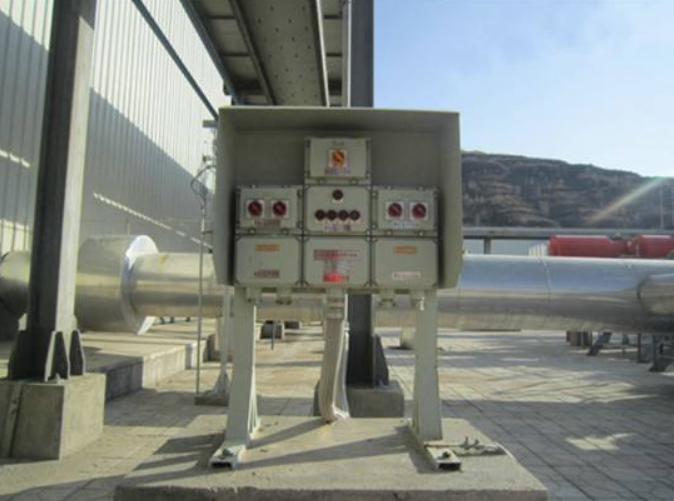
1.3 Electrical equipment should be installed according to the prescribed technical documents. The power supply of electrical equipment should be equipped with appropriate protective devices to prevent harmful effects caused by overload, short circuit, open circuit, or grounding faults. For example, the increased safety squirrel cage motor should be equipped with a reverse time limit protection device. The short-circuit and ground fault protection devices should be able to prevent automatic reclosing under fault conditions. Be sure to ensure that the replacement items, such as replacing light bulbs, have a type and rating that matches the usage requirements. The equipment installation is completed, and the initialization check of the equipment and installation should be carried out in accordance with IEC60079-17.
1.4 Explosion proof electrical equipment should be installed by construction personnel with professional knowledge. The installation quality should meet national standards such as GB50257 and GB3836.15. When necessary, professional explosion-proof organizations can be commissioned to implement engineering supervision or on-site guidance for engineering installation to ensure that the project meets the overall explosion-proof standards.
1.5 Proper installation of electrical equipment requires attention to the following points for existing installations or expansion of existing installations:
1.5.1 Place classification documents;
1.5.2 Equipment installation and connection instructions;
1.5.3 Explanatory documents for intrinsic safety systems;
1.5.4 Manufacturer's/Qualified Personnel Declaration.
During installation or maintenance, it is necessary to cut off the power supply of the front stage and follow the warning requirements in the product manual, such as "Do not open the cover with power on" or "Open the cover after XX minutes of power-off". After cooling, open the cover to avoid accidental injuries such as electric shock and burns.
If subjected to vibration, special attention should be paid to the tightness of equipment bolts and cable entry devices. When cleaning non-metallic electrical equipment, attention should be paid to avoiding the generation of static electricity.
The installation and use of explosion-proof electrical equipment should prevent adverse effects on explosion-proof performance caused by external factors (such as chemical reactions, mechanical reactions, heat, electrical, and moisture), and measures should be taken to prevent foreign objects from falling vertically into the ventilation openings of vertically installed motors.
1.7.1 Moisture and Waterproof Measures:
For outdoor places, explosion-proof electrical appliances should be placed under rain shelters as much as possible to avoid direct rain and direct sunlight, and products with higher protection levels should be selected as much as possible. Seal the entrance of the electrical circuit. And take measures to prevent water accumulation near explosion-proof electrical appliances. Apply waterproofing agent to the threaded connections of the installed wiring conduit;
1.7.2 Anti corrosion measures:
According to the presence of corrosive gases, liquids, and vapors in the environment, in addition to selecting explosion-proof electrical appliances with corrosion resistance, anti-corrosion treatment should also be carried out on the wiring pipelines.
1.7.3 Heat prevention measures:
Try to keep explosion-proof electrical appliances away from heat sources and choose explosion-proof electrical appliances with higher temperature levels as much as possible.
1.7.4 Earthquake prevention measures:
Try to use copper core insulated flexible wires or copper core multi strand cables. When wiring with metal pipes, flexible connecting pipes can be installed at the connection between explosion-proof electrical appliances and electrical circuits as needed. Spring washers and double nuts are used for bolt fasteners that are susceptible to vibration to prevent loosening.
1.8 Requirements for Wiring and Grounding:
1.8.1 The connectors and grounding terminals should have sufficient mechanical strength and ensure reliable connection. Despite being affected by temperature changes, vibrations, and other factors, poor contact should not occur. If aluminum core cables are used, transition joints must be used to prevent electrolytic corrosion.
1.8.2 The metal casing of electrical equipment and the junction box of armored cables must be equipped with external grounding bolts and marked with grounding symbols. Portable and mobile devices do not have external grounding bolts, but must use cables with grounding cores.
1.8.3 The electrical equipment junction box must be equipped with dedicated internal grounding bolts and marked with grounding symbols. When using the direct introduction method, it is inside the main cavity. However, the electrical equipment on the electric locomotive does not require internal or external grounding bolts.
1.8.4 Pipelines that transport combustible gases or liquids cannot be used as grounding wires. If the equipment is installed on a grounded metal frame or installed using a well grounded conduit wiring method, it can be considered as having an external grounding. Electrical equipment should be equipped with grounding connectors next to the circuit connectors in the wiring cavity.
1.8.5 The connection between electrical equipment and grounding wire should use multi strand flexible stranded wire, and the minimum cross-sectional area of the copper wire should not be less than 4mm ². Protective tubes should be installed in areas prone to mechanical damage.
The diameter of the internal grounding bolt in 1.8.6 shall comply with the following regulations:
a) When the cross-sectional area of the conductive core wire is not greater than 35mm2, it should be the same as the diameter of the wiring bolt;
b) When the cross-section of the conductive core wire is greater than 35mm2, it should not be less than half of the bolt diameter connecting the cross-section of the conductive core wire, but at least equal to the bolt diameter connecting the 35mm2 conductive core wire.
1.8.7 The specifications of external grounding bolts shall comply with the following regulations:
a) Equipment with power ranging from 250w to 5kw, not less than M6;
b) Equipment with a power not exceeding 250W and a current not exceeding 5A, not less than M5;
c) For intrinsically safe equipment and instruments, the external grounding bolt should be able to tighten the grounding core wire;
d) The grounding bolt should be made of stainless steel material or treated with electroplating rust prevention.
When wires or cables are introduced or removed from explosion-proof products, the original rubber sealing rings and retaining rings must not be discarded and directly connected with copper or flexible pipes. The sealing must be fully compressed. The outer diameter of wires and cables should be compatible with the inner diameter of the sealing ring (users should ensure that the minimum size of the selected cable, including tolerances, is greater than or equal to the required value of the cable sealing ring). The rubber sealing ring material should comply with the aging test in the relevant type test, and its shape should be suitable for the installation of the cable used. Redundant cable entry ports should be sealed with blind gaskets or metal plugs. Multiple cables are not allowed to enter the same entry device at the same time. Cables used in hazardous areas must not have intermediate joints.
The explosion-proof surface of the 1.10 explosion-proof product is the basic guarantee of its explosion-proof performance. Strict protection should be taken to avoid collision, abrasion, and scratch, and there should be no sand holes. The explosion-proof surface of each product must be coated with anti rust oil before leaving the factory, and painting is strictly prohibited to prevent oxidation and rusting of the explosion-proof surface. Pads can only be used when permitted by document regulations. The joint surface shall not be treated with substances that have hardened during use. If rust proof oil is found to be dry or reduced, it should be replenished in a timely manner to ensure the normal operation of explosion-proof. The fastening bolts of the explosion-proof joint surface shall not be replaced arbitrarily, and the spring washers shall be complete.
When installing junction boxes for external wire or cable connections, attention should be paid to ensuring that the electrical clearance and creepage distance meet the requirements of the corresponding standards. (Should meet the relevant requirements in GB3836.3-2010 and GB/T 14048.1-2000)
1.12 All fasteners are equipped with spring washers as anti loosening measures and cannot be discarded. They must be fully tightened each time to flatten the spring washers. Only tools are allowed to loosen or remove fasteners necessary to ensure explosion-proof type or to prevent contact with exposed live parts.
The fitting clearance of explosion-proof products with 1.13 sealing, cylindrical, and threaded explosion-proof structures is usually between 10-20 μ m, and the average roughness of the explosion-proof joint surface does not exceed 6.3 μ m, which is very precise. Therefore, when opening or separating, attention should be paid to maintaining balance, light force separation, and strict pulling and pulling are strictly prohibited to avoid damaging the explosion-proof performance.
When installing equipment, attention should be paid to preventing the distance between the explosion-proof joint surface and solid obstacles (such as steel frames, walls, sheaths, installation plates, pipelines, or other electrical equipment) from being less than the values specified in the table below, except for those that have been proven to have a smaller isolation distance through testing.
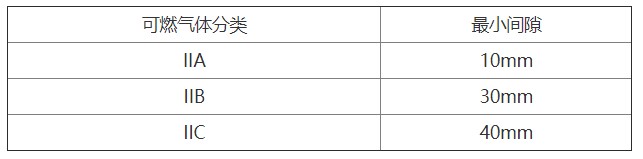
When reassembling the explosion-proof shell, all joint surfaces should be completely cleaned and coated with appropriate grease to prevent corrosion and increase climate protection. Bolts that do not pass through holes should not be coated with lubricating grease. When cleaning flanges, only non-metallic scrapers and non corrosive cleaning solutions can be used. The clearance between the stopper, shaft, control rod, and threaded joint surface generally does not need to be checked, except for signs of wear, deformation, corrosion, or other damage, in which case the manufacturer's documentation should be followed.
1.16 In order to inspect and maintain, the following new documents should be provided
a) Classification of hazardous areas;
b) Equipment level and temperature group;
c) Records that enable the maintained explosion-proof electrical equipment to comply with its explosion-proof type (such as equipment list and configuration, spare parts, technical data, and manufacturer's user manual);
1.17 The entire set of devices or equipment should undergo an initial inspection before being put into operation. To ensure that electrical equipment is in good condition and can be used in hazardous areas for a long time, one of the following two inspections should be conducted:
a) Regular inspection
b) Continuously supervised by professionals and maintained as necessary.
Specific inspection items can refer to relevant standards (see Appendix 1 and Appendix 2).
At any time, if there is a change in the classification of hazardous areas or a change in the location of electrical equipment, an inspection should be conducted to ensure that its explosion-proof type, equipment category, and temperature group are suitable for the changed conditions. If the device or equipment needs to be dismantled during inspection, measures should be taken to ensure that the overall explosion-proof type is not damaged when reassembling.
In areas where professional personnel have indicated changes in environmental conditions (such as solvent intrusion or increased vibration), components of explosion-proof equipment affected by these changes should be inspected more frequently.
1.18 North American standard NPT threads cannot be connected to British threads. When connecting NPT threads, corresponding reliable tightening and anti loosening measures should be taken.
1.19 Cables and wires can be connected using one of the following two methods:
a) Indirect introduction, using junction boxes or plug-in devices for connection.
b) Directly introduce, using the connection method inside the casing. Electrical equipment does not generate sparks, arcs, or hazardous temperatures during normal operation; The rated power is not greater than 250W, and the current is not greater than 5A. Direct introduction is allowed.
Regardless of the introduction method used, measures should be taken to prevent damage to the wiring terminals when the cable is dragged or twisted.
When checking the tightness of cable entry devices in general, it can be done by hand without removing climate protection or protective covers. Avoid excessive force, as it may damage the internal wires. Detailed inspection can dismantle the cable entry device.
1.20 All wire and cable joints must be firmly pressed to avoid poor contact or short circuit. For example, when replacing a light bulb, the contacts of the bulb must be tightly pressed against the lamp holder and cannot be shaken.
1.21 Anti condensation devices, such as breathing elements, drainage elements, or heating elements, should be inspected to ensure proper operation.
1.22 When it is necessary to open the equipment casing (devices other than intrinsic safety circuits) for inspection, attention should be paid to isolating the relevant connections (such as inputs, neutral wires, outputs, etc.), that is, unplugging fuses and fuses, or disconnecting isolators and switches, until there is enough time for the surface temperature or stored electrical energy to drop to a level that cannot cause ignition before opening the casing.
During the use of 1.23 explosion-proof products, dust will continuously accumulate on the outer surface, affecting the heat dissipation of the shell. To ensure the normal operation of the product, the surface dust should be cleaned at least once a month. When wiping the surface of non-metallic products, only a damp cloth should be used to avoid static electricity and ignition.
All parties involved in the design, production, inspection, use, and maintenance of explosion-proof electrical equipment must fulfill their respective responsibilities based on the requirements of "overall electrical explosion-proof". Caution to avoid: Explosion proof host, non explosion proof accessories; Equipment explosion-proof, instruments not explosion-proof; Part of the same type of equipment is explosion-proof, while the other part is not explosion-proof; Incomplete explosion-proof equipment models, mismatched spare parts, and construction issues, etc.
Service Hotline: 18924609560 (same WeChat account)
.jpg)




 |
||||||
 |
||||||
|
||||||
 |
||||||
|
||||||
 |